

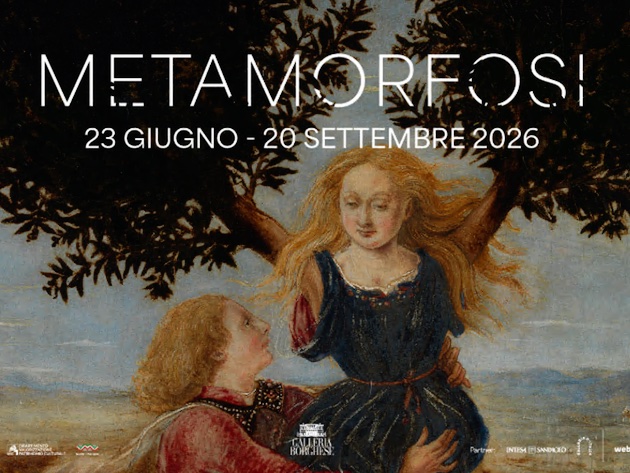
A journey through myth, art and transformation in the heart of Rome
There is a special way to discover Rome: by allowing yourself to be guided by its stories, stepping inside its historic palaces and discovering how, over the centuries, artists have transformed ancient myths into images that still have the power to move us today.
This is the journey offered by “Metamorphoses. Ovid and the Arts”, the major exhibition hosted in the magnificent rooms of the Galleria Borghese, created in collaboration with the Rijksmuseum in Amsterdam and curated by Francesca Cappelletti and Frits Scholten.
It is a perfect exhibition to include in your Roman stay, especially if you wish to experience the city not only through its most famous landmarks, but also through the stories, passions and symbols that have helped shape the European imagination.
Ovid and the timeless fascination of transformation
At the heart of the exhibition are Ovid’s Metamorphoses, one of the most influential works in Western culture.
In Ovid’s poem, everything can change: human beings can become plants, animals or stars; gods intervene in the fate of mortals; and nature itself becomes the stage for passions, desires, revenge and transformation.
Metamorphosis therefore becomes much more than a narrative device: it is a key to understanding the world, nature and the human condition.
It is precisely Ovid’s extraordinary ability to explore the instability of life and the constant transformation of forms that has fascinated generations of artists.
From the great masters of the Renaissance to Rodin and Brancusi
The exhibition takes visitors on a journey through centuries of art history.
Works by the great masters of the Renaissance and Baroque, including Correggio, Michelangelo, Titian and Rubens, are presented alongside those of the Classicist master Poussin and artists from more recent eras, such as Gérôme, Rodin and Brancusi.
The result is a fascinating journey in which the same myth takes on completely different forms depending on the period, artistic sensibility and individual perspective.
Naturally, the exhibition also highlights the masterpieces of Gian Lorenzo Bernini housed within the Galleria Borghese. In particular, Apollo and Daphne and Pluto and Proserpina seem to capture the very moment of transformation: marble appears to move, bodies seem to come alive, and myth becomes an experience that unfolds just a few steps away from the viewer.
A perfect setting for the exhibition
The choice of the Galleria Borghese as the setting for this exhibition is far from accidental.
The history of the Villa and of Cardinal Scipione Borghese is deeply connected to the relationship between art, mythology and self-representation. The Casino Nobile was created to house part of his extraordinary art collection, within a vision in which architecture, sculpture and painting were conceived as elements of one coherent cultural narrative.
Walking through the rooms of the Galleria therefore means entering directly into the very universe explored by the exhibition.
It is an experience in which the setting and the artworks come together, creating a particularly evocative dialogue between seventeenth-century Rome, the myths of antiquity and the interpretations that artists have given them throughout the centuries.
An invitation to discover Rome through myth
“Metamorphoses. Ovid and the Arts” is much more than an exhibition devoted to mythology.
It is an opportunity to rediscover how relevant stories written almost two thousand years ago still are today: stories of love and desire, loss and rebirth, power and violence, gods and mortals, nature and transformation.
After a stroll through the heart of Rome, spending a few hours at the Galleria Borghese means allowing yourself a moment of beauty and wonder, surrounded by works that have travelled through time and continue to tell stories that remain profoundly human.
If you are planning a stay in Rome, this exhibition can become one of the most fascinating highlights of your journey. After admiring Apollo and Daphne, Pluto and Proserpina and the other masterpieces of the Galleria, you can continue exploring a city where past and present constantly meet.
Because, just as in Ovid’s Metamorphoses, in Rome everything changes, yet nothing ever truly stops telling a story.